
General
Front and Back Copes
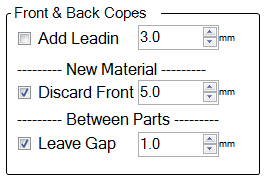
Add Lead-in adds a small line to the beginning of each cut. This Lead-in can minimise damage to edge of the part during piercing. This will add to the required nest length. (Normally OFF)
New Material: Discard Front will discard the specified amount from the leading edge of a new piece of material. This is useful for stock that has excessive burrs or roughly cut ends. (Normally ON – 5mm)
Between Parts: Leave Gap will leave a small amount of stock between
each part. This is useful if the rear end of a part has weld preps or other
features that tend to damage a portion of material after the previous part. (Varies – Often ON)
Extra Cut-offs (Every Part)
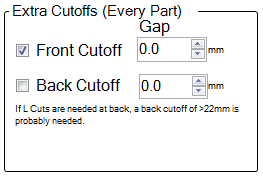
Front Cut-off will add a buffer of the specified amount of material at the front of each part. This is similar to the Discard Front function above but applies to every part (Normally OFF)
Rear Cut-off will add the specified buffer to the rear of the part. This may be required on special types of copes where the torch needs extra clearance when cutting inside the flange area on beams or columns. (Normally OFF)
Bevels
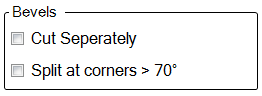
Cut Separately will split any corners that have different angle weld preps (i.e.: If a straight cut meets a 45-degree weld prep). This will cause the machine to stop at the end of one cut, reposition to the new angle, pierce and then continue to cut the next line. (Normally OFF)
Split at Corners > 70 degrees
Irrespective of the previous setting, this will cause the machine to add a
split between cuts on sharp corners. (Normally
OFF)
Bevels Over Limit
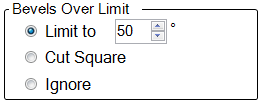
These option buttons affect the behaviour when a file specifies a weld prep greater than what is possible. (Usually 50 degrees is the limit)
Limit to XX degrees. If a file specifies 70 degrees for example, the machine will limit it to the degrees specified. Every attempt is made to ensure that the cut keeps to the longest edge of the bevel so that it can be manually ground back to the desired angle (Normally ON)
Cut Square will simply perform a square cut at 90 degrees to the surface at the longest point in the bevel. (Normally OFF)
Ignore will leave any excessively angled bevel cuts completely un-cut. These will need to be cut by other methods afterwards (Normally OFF)
Stitching
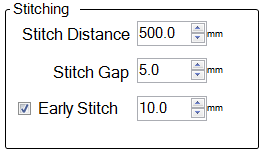
Stitching is a method of leaving small tabs of metal at a predetermined distance along lengthy cuts. This is vital especially when splitting beams or columns length-ways as they tend to bow considerably as the internal stresses are relieved during cutting.
Stitch Distance specifies how often a STITCH is placed along long cuts.
Stitch Gap is the amount of distance the torch will skip when leaving a stitch (Add a little extra to allow for the pierce diameter – for example if you want 5mm of metal you may need enter 8mm or more as the distance)
Early Stitch will place an extra stitch at the start and end of long cuts. This is vital in order to avoid the ends splaying apart and causing problems with the beam feeding mechanism